
I thought I was ready. I thought I was ready. But as the days leading up to the Launch Party, I became gripped with nerves and unending fear.
It wasn’t just that it was something I’d written. It was that it was real. That the poems I’d written in the rawest moments of my life: in relapse, in grief, in clawing my way back toward something like hope; they were now bound in paper and ink, sitting in the open for anyone to pick up. Anyone, anywhere in the world, could learn the truth I’ve carried in my bones for over a decade: I’m an addict.
And not the movie-version kind with an easy redemption arc. My pages hold the mess. The relapses. The shame. The rage. The nights I didn’t want to live and the mornings I woke up anyway. I’ve never been shy about writing from the gut, but seeing it out there, in the wild, with no way to pull it back once it’s read… that’s a different kind of vulnerability.
A part of me wanted to call my publisher and cancel the whole thing. Pull the plug on publishing the book. Done. Free. But this was not something I could run from. No, I was here to carry the torch of a larger message: that coming back into recovery is hard, and scary. But worth it. Because not everyone makes it back to recovery. A great deal of people die. I am by no means unacquainted with death. I’ve buried countless friends in the last fifteen years. Aside from my two grandmothers, they were all under the age of forty.
The Journey From Kansas to Pennsylvania

But then came the trip home. Back to Pennsylvania. Back to Brown Hill, the neighborhood that raised me. As soon as I turned off the interstate and onto familiar roads: Girard, Edinboro, Mill Village, then the drive up the main road in Brown Hill, I was met with the delight of familiarity, fields growing corn, soybeans, stretching for acres as we passed them by. It smelled like late summer: sun-warmed dirt, cut grass, the faint tang of diesel from the tractors that have been there longer than I’ve been alive.
By the time I hit the main road leading into Brown Hill, my heartbeat was a drum in my chest. Every bend in the pavement brought me closer to the driveway I’d pulled into thousands of times, but this time was different. I hadn’t seen my dad in a year and a half. That kind of time stretches and frays a connection in ways you can’t feel until you’re right there on the edge of it.
When I finally turned onto his street, I could feel the excitement flooding my whole body. I don’t know if I was smiling or just trying not to cry. Then the house came into view — the same siding, the same porch light, the same space that has always smelled faintly of fresh cut grass and old wet firewood. And there he was, standing outside, waiting. He looked exactly the same and somehow different all at once. I got out of the van, and before I even shut the door, we were hugging. A long, tight, we’re-both-still-here kind of hug.
Launch Day!

The day of the launch party, my nerves were doing laps in my chest before I’d even left the driveway. The bookstore was too far from my dad’s for the nerves pounding in my chest, but my mind was miles ahead, imagining every possible version of the night, people showing up, people not showing up, my voice cracking during a reading, or maybe finding some impossible calm.
When I walked through the door, I spotted her instantly, Chelsea Schermerhorn, the woman behind Bluebonnet Books LLC. We’ve been messaging for months, working through edits, layouts, deadlines, but meeting her in person was something else entirely. She’s warm in a way that’s not forced. A steady presence. The kind of person who makes you feel like you’re not just another name on her list. We hugged like we already knew each other because, in a way, we did. We’ve shared this book for months, both of us in our own ways, and now here it was, out in the world, on a stand by the door, waiting.
I glanced at it again before we started. The cover art, the title, my name. I thought about the people who would wander in and pick it up without knowing anything about me. I thought about the ones who’d read the first poem and close it fast, and the ones who’d carry it home and see themselves in it.
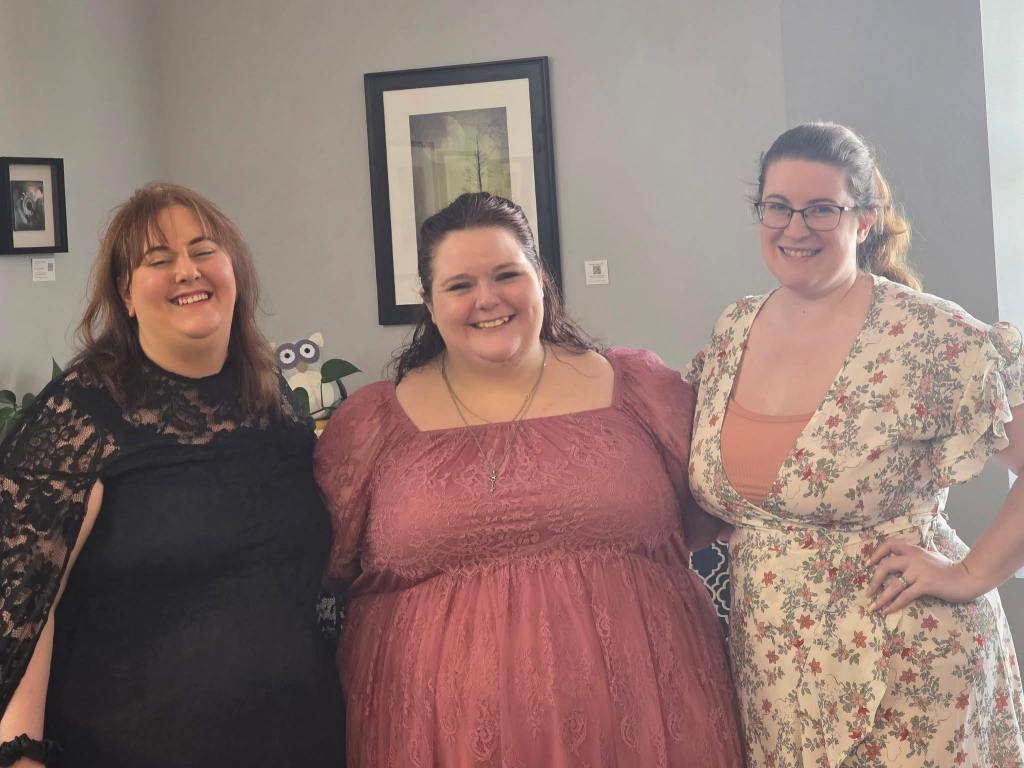
Standing there with my dad, mom, sibling, aunts, and a cousin, with Chelsea by my side, I realized that this is what it means to let go. To write something true and send it out, knowing you can’t control who holds it or what they take from it. Knowing the most dangerous and the most beautiful part is the same: it’s not mine anymore.
When the Poems Met the Room
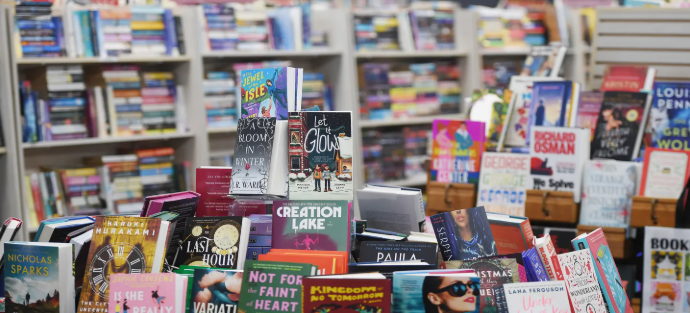
As I got out of the van in front of Werner Books (of Erie, Pa.- go check them out if you’re in the area!), I was flooded with fear, anxiety. It felt like it was pouring out of my pores. The book shop is beautiful. It felt like a place I would frequent, well frequently, if I lived in the area.

That evening, the space felt alive in a different way. A table near the front had been cleared to make room for stacks of Ink, Blood, & Prayer, each copy propped at a slight angle so the cover seemed to lean toward you. My cover. My name. It still felt strange to see it under those lights, among the works of people whose words I’d devoured over the years.
Chelsea was already there when I arrived, moving through the space with that calm, grounded energy she carries. She greeted me with the same warmth I had experienced from her messages for all these months. I remember thinking then that this was exactly the kind of person I wanted behind my book.
I’d been up early that morning, nerves already jangling, sitting at my dad’s dining room table with a glass of orange juice, scribbling and rewriting my reading intro. I wanted something that would welcome people in without softening the truth of the work, something that could set the tone without sounding like a lecture. I kept scratching out lines, rewriting them, then reading them aloud to the empty kitchen until they felt right in my mouth.
When it came time to read, I stood in front of the small crowd, my hastily handwritten introduction in my hands. My palms were damp, my throat dry. I took a breath, read my intro that I had just written hours before, and then opened to the first poem I had selected.
“The stories we tell literally make the world.” – Ken Burns
Reading aloud is a strange kind of intimacy. The words that lived in my body for so long, that I whispered to myself in dark rooms and scratched into notebooks, were now carried into the open air. I could feel the weight of people listening, the way the room seemed to still at certain lines, the collective exhale after a particularly heavy verse.
Halfway through, I realized I’d stopped worrying about my voice shaking. The poems had taken over. They knew how to hold themselves.
After the last reading, there was a beat of quiet before the applause. Then people stood, some moving toward me with their books clutched to their chests, others waiting in line to have them signed. My pen felt clumsy in my hand, but I wrote each name carefully, choosing the words to write by my relationship with each individual.
The conversations at that table are what I’ll remember most.
There were hugs. There were quiet thank-yous.
It struck me, again, that I couldn’t control where these words would land. That they might be picked up by someone who’s never known addiction, or someone who’s fighting it right now, or someone who loves a person they can’t save. That’s the risk and the gift of letting a book into the world, it becomes part of other people’s lives in ways you’ll never see.
It was from knowing that, for one night in a small bookstore in Erie, Pa., I had put my whole truth into the air, and people had listened.
When the Dust Settles on the Pages
The rest of the time visiting home was wonderful. Filled with family and our favorite things: from lounging at the lake to ice cream at Little Cooley’s Dave’s Place. It was exactly what I need to feel back on track with my life.

As readers have finished the book, it has received some lovely praise. I am overjoyed that not only did they read it- they wanted to tell the world about it too!

The kind words of readers really brought me back to the center of why this project was so important. What I’ve experienced in literature about recovery, it showed a straight line or a try and a fail. Others wrote about those that got sober and stayed that way their whole lives, a straight line. Simple, blessings pouring into their lives every step of the way. Still others wrote about someone who tried a 12 step recovery program for a few meetings, then they drank or used for years until the toll had been taken on their body.
I know these stories are accurate portrayals of some journeys. I’ve seen my fair share of these things happening to people I know or once knew.
This just wasn’t my journey.
That was what I wanted to get out into the world. To show that there is life, there is hope, after relapse. That picking up the first one after a stint of recovery doesn’t sign your death warrant. The sad reality of this disease is that that does become the case in many circumstances.
There are other options though. Relapses can happen to anyone. My relapses did not kill me. I grew through them. I learned from them. I wanted a message out there that shows there is hope in trying again. Picking up that white coin, token, or keytag again. A fresh start is not starting over. It’s adding on to your previous knowledge and building from there.
Trading Verse for Voices
When Ink, Blood, & Prayer came out, it carried all the parts of me I used to hide. Relapse. Shame. The ugly truths about staying alive when it would’ve been easier not to. It’s a book in fragments because that’s how those years existed in my body: flashes, moments, survival in pieces.
But even while I was finishing that collection, another story had been simmering. A different kind of truth. One that couldn’t be told in a handful of lines.
Where the Music Finds Us is my first novel, and it’s built around Liora, a woman living in Marseille, steeped in music and memory, not looking for anything when she walks into a bar called La Lune Rousse on April 20, 2024. The red light, the smoke curling toward the ceiling fans, the band onstage. There in the thick of it all we meet Bastien and Eli.
Bastien: the bassist, steady, quiet, all slow movements and careful hands.
Eli: the lead singer, sharp-edged and restless, always carrying a grin like it’s a secret.

The book follows what happens when the three of them stop orbiting and start colliding. It’s a love story, but not the tidy kind. It’s about polyamory and queer intimacy, about the way desire tangles with grief, about trying to hold space for each other’s ghosts. It’s about the heat and the tenderness, the jealousy and the belonging, and how music can crack you open when you least expect it.
The shift from poetry to prose was like learning a new instrument. In poetry, I cut to the bone, a single image, a single heartbeat. In prose, I could let the moment breathe. I could stay in the room longer. I could show the before and after, not just the flash in between.

I think of Ink, Blood, & Prayer as the inhale: sharp, unflinching, necessary. Where the Music Finds Us is the exhale: slower, deeper, but still carrying the weight of everything that came before.
Promoting one book while editing another is strange. I’m still hearing from people who just finished the poems, who found themselves somewhere inside them. At the same time, I’ve finished my edits on Where the Music Finds Us, handing it over to my publisher. All the while, beginning to outline the second book in the trilogy.
If the poems were the truest way I could speak about my own survival, the novel is my way of speaking about what makes survival worth it.
Sneak Peek: Where the Music Finds Us
When the door swung shut behind her, the city faded. In its place: cymbals, laughter like breath through teeth, bass trembling through the soles of her feet—music that felt like home, even now.
La Lune Rousse lived up to its name. Dim red lights illuminated old brick walls, and smoke curled in lazy spirals towards the ceiling fans; people already occupied half the tables. A bartender in a cut-off tee and leather apron gave her a once-over, then a nod.
“Tequila Añejo, avec des glaçons,” Liora said, voice low and sure.
The glass arrived a moment later, amber and clean, sweating slightly in the heat. She slid onto a stool at a small corner table near the edge of the stage. Not too close. Just close enough to watch.
She sipped slowly, letting the heat of the tequila curl in her chest, grounding her. She glanced up at the makeshift stage.
The drummer caught her attention first. A small woman with curls tucked into a bun and forearms like stone. She moved with quiet precision, adjusting her kit in silence, tapping the snare once, twice, tightening something on the hi-hat.
Two men stood nearby, deep in some sound check ritual. One of them was tall, golden-skinned, his dirty-blonde hair a shaggy mess hanging to his chin. He tuned his bass with a kind of quiet reverence, slow fingers coaxing sound from the strings, his bare feet tapping to a rhythm she couldn’t hear yet.
The other, with dark-haired curls in a messy mullet, moved with more restlessness. A flicker of chaos. He laughed at something the other man said, grinned wide, scratched behind his ear, then crouched to mess with the pedal board like he was trying to solve a riddle only he could hear.
The first song hit like a warning. A low swell of sound that curled under her skin, vibrating with something half-remembered and half-feared. It wasn’t just music. It was a shift in pressure, a door creaking open inside her.
Liora didn’t catch the title, but it didn’t matter, everything about the band’s energy was immediate. Raw. In French, thick with vowels that curled around the guitar riffs and landed hard on the downbeats. The sound filled the bar like smoke, like sea wind through broken windows.
She nursed her drink slowly, enjoying each silky taste, caramel, vanilla, and baked agave hitting her tongue with each sip and ending in a lingering earthy heat. The smell of vanilla and toasted oak wrapped around her as she sat back and allowed the experience to enrich the sound of the music.
The band played five songs before anyone in the crowd said a word. They sang each song in French, with bite, with ache. The drummer never smiled, just moved like she’d been born with sticks in her hands. The bassist was steady, all calm and firm, dressed in an open blue linen shirt. She could see the sweat glistening across his chest. And the lead singer-guitar slung low, curls damp at his temples-sang like someone tearing pages out of himself and holding them up to the light.
As the sixth song hit it’s opening notes, a hush spread from the stage like a tide rolling in. The lead guitarist stepped to the mic, adjusted it with one hand. His voice was quiet at first, almost conversational.
The first line: “I drank from the bottle they buried with my brother.”
English.
Liora blinked, caught off guard. Her glass paused midair. The melody was haunting, slow and smoky, with a rise on the chorus that felt like a tide lifting everything not nailed down.
“Glass Bottle Gospel.”
The set list, which she’d only half-read by the door, had the name written on it in chalk, but she hadn’t expected it to sound like this. Like heartbreak with a backbeat.
It was then, his eyes found hers, the curly haired lead singer.
Mid-verse. A slow, deliberate look. Not curiosity. Not flirtation.
Recognition.
Liora felt it in the base of her throat.
He said something to the bassist between lines, too low to catch, but the bassist looked up mid-play, scanning the room until his gaze landed on her.
She held it. Her pulse kicked hard once, but she didn’t look away.
The jukebox sobs in a minor key-
Even sin gets lonely when it’s just like me.
I’ve carried pieces of this story for years without realizing it. Little fragments, the way a song can turn the air electric, the particular kind of recognition that happens when you lock eyes with a stranger and feel like you’ve known them forever, the way music can break you open and hold you together.

I grew up at The Hangout and sometimes Forward Hall, in Edinboro, Pa. and Erie, Pa. My teenage years were spent holding up an arm to keep the circle pit from crashing into me. Times spent sitting on the front sidewalk of the Hangout drinking Jones Soda. The spray painted walls in one room, filled with things that teenagers can use to wile away the days. The other room, loud, crashing guitars. Vocals fitting in seamlessly, or not at all. Every show wasn’t perfect. But that was the beauty of it. We weren’t perfect either.
When I was writing Ink, Blood, & Prayer, I was telling the story of my own survival, the raw fight to keep breathing, the truth about relapse, the way shame and sacred rage can live side by side. But when I reached the other side of that book, I found myself asking different questions. Not just How do I keep living? but What makes it worth it to stay?
That’s where Where the Music Finds Us comes from.
It’s a book about intimacy, not the easy kind, but the kind you have to risk yourself for. About the messy edges of love, especially when it refuses to fit into the neat boxes we’re taught to expect. About grief that doesn’t fade, but changes shape when it’s witnessed by someone else. And about music, because for me, music has always been a language that can say things words can’t.

I wrote it now because I finally had the space, in my life and in my heart, to explore love stories that are as complicated as they are beautiful. I wanted to write about characters who love without apology, who are tender and reckless in equal measure, and who understand that sometimes the most important thing you can give someone isn’t forever, it’s the truth.
And I wrote it because I wanted to put joy on the page alongside the ache. Not instead of it, but with it.
From My Desk to Your Hands
If Ink, Blood, & Prayer has spoken to you, there are a few ways you can help keep it alive in the world. The simplest and most powerful thing you can do is buy a copy, for yourself, for a friend, for someone you know will see themselves in its pages. You can find it at:
Reviews?
Another way to make a huge difference for a small-press author like me is to leave a review. It doesn’t have to be long or polished, even a couple of sentences saying what the book meant to you helps more than you can imagine. Reviews tell booksellers and algorithms that this work matters, and that’s how it finds its way to more readers. You can leave them on Amazon, Barnes & Noble, or Goodreads.
Newsletter?
If you’re already looking ahead to Where the Music Finds Us, you can sign up for my mailing list so you’ll know the second preorders go live. Subscribers will also get first access to behind-the-scenes notes, early excerpts, and event announcements as we get closer to release day.
Pass Along the Poetry
And if you’ve already read Ink, Blood, & Prayer, consider sharing it with someone you think might need it. This book was never meant to just sit on a shelf. It’s meant to be passed along, dog-eared, underlined, and left on nightstands for people who need to feel less alone.
Your support, in whatever way you give it, is what makes it possible for me to keep writing the stories and poems I believe in. Thank you for helping me put them in the hands of the people who need them most.


 Kiera Gerety
Leave a comment